31 Jan 2012

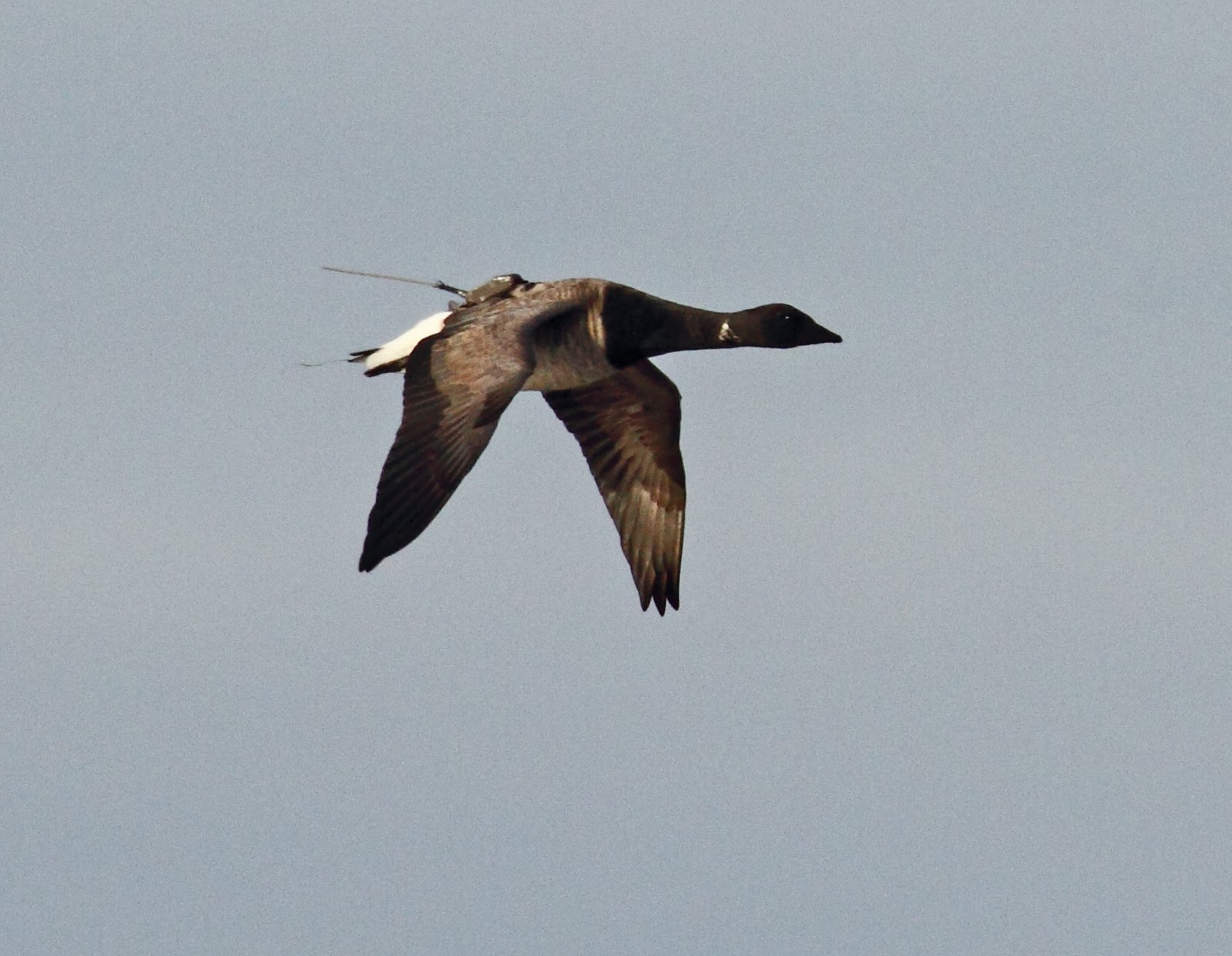
13 October: Fridtjof airborne over Lindisfarne

Thursday 13 October Bryan Galloway, Peter Fawcett and some other local birders walked out to Beal Point to watch birds, where Bryan Galloway suddenly spotted a flying goose with a satellite transmitter. The day after we received an email with this stunning picture of Fridtjof in flight with his satellite transmitter – and the message “Please find some photographs of a Brent Goose which I saw at Lindisfarne yesterday. I think it must be Steve or Ebbe. We had a great day watching the hundreds of Brent geese resting and flying over the sands at Lindisfarne. Suddenly, out of the blue, out popped this one with a transmitter on its back. It looked in good shape”. We could, however, identify the bird as Fridtjof from the barely visible combination of a red above white ring on the birds right foot. Photo courtesy of Peter Fawcett (c)

8-9 October: Steve observed by Steve in Lindisfarne

 In the week-end Steve Percival went on a field-trip to Lindisfarne. Steve studied the Light-bellied Brent Geese intensively at Lindisfarne from 1990 through 2000, and have caught and ringed 333 birds on the site. He found a pair of ringed birds – and realized that one of them had a transmitter. Although he could not read the letter on the yellow ring, the combination of a pair where both birds had white over green on their right leg, the male had a transmitter, and the female Yellow S on its left leg, make it possible to identify this as being gander Steve named after Steve! 

14-24 September: Niels flies south with a distinctly different behavior

In contrast to the other birds, that all flew almost non-stop and fairly directly to Lindisfarne, Niels had a distinctly different behavior – where he gradually moved south with a lot of small jumps. His exact departure from Svalbard is unknown. On 14 September he was located northeast of Hitra and from there he gradually and slowly moved south along the west coast of Norway to Skoltafjorden north of the island Stolmen.  No signals have been received from the PTT after 24 September.

18 September: All birds with known final destiny now in Lindisfarne

We so far managed to follow four individuals successfully to their first autumn staging area. With the arrival of Fridtjof in Lindisfarne on 18 September in the evening, all these birds surprisingly flew into Northeast England. Lindisfarne is a well-known wintering site which since the mid-1980s typically has been used by half of the flyway-population from October through December. The other half fly to wintering sites in Denmark – mostly in the northeastern parts of the mainland Jutland. Hence it is a bit surprising that all bird managed to follow through to the wintering areas all went west.  

12 September: Contact with Caretaker lost in southwestern Norway


Caretaker was still on Svalbard 3 September. Next locations we have are from his passage over the Barents Sea from Svalbard towards mainland Norway, where he on 9 September at 6:00 in the morning were southwest of Bjørnøya and at 17:00 reached Andøya in Lofoten. During 10-12 September he gradually moved south along the west coast of Norway to the coastline between Revtangen and Hå 25 km southwest of Stavanger. No signals have been received from the PTT after 12 September.

21 Sept 2011

18 September: Steve races down to Lindisfarne

Steve beats them all again. Just as in spring, where he flew almost non-stop to Svalbard, he also made a very fast flight at least from Lofoten down to Lindisfarne. The pictured flight of 1889 km started west of Lofoten at 17 September at 08:00 and ended in Lindisfarne on 18 September at 21:00, thus took 37 hours with an average speed of 51 km/hour

15 Sept 2011

15 September: Ebbe and Loff flying in to United Kingdom

The transmitters batteries obviously benefits from the birds flying south to better insolation regimes, where the solar panels can restore their voltage. Thus the PTTs of Ebbe and Caretaker both began to collect GPS locations when they had migrated south to 63°N. The maps shows their routes over the eastern Atlantic and North Sea where Ebbe settled at Lindisfarne, whereas Caretaker surprisingly flew over Lindisfarne and continued further north to Firth of Forth near the Bay of Leven. Ebbe followed a route near the Norway coast whereas Caretaker followed a route over the open ocean.

13 Sept 2011

12 September: four birds still on Svalbard

Four birds are still located on Svalbard, but now in the southern parts of the archipelago. The upper map shows how Fridtjof who resided on Reinsdyrflya 9 September during 12 September flew south towards Nordenskiöldkysten. The lower map gives the same overall movement for Steve, although he took a slightly different route. Loff is still at Van Mijenfjorden (upper map) and Niels at Edgeøya near Kap Lee (lower map). Maps reproduced with permission from Norwegian Polar Institute using TopoSvalbard

12 September: Caretaker first bird heading south

Our study has over the past few weeks suffered increasingly from depleted batteries, and all transmitters stopped collecting GPS locations. We thus only recieve doppler-data every third day, when the transmitters uplink to the satellites. Fortunately Caretaker flew south over the Barents Sea on such a day, and the upper part of the map shows his flight from Svalbard to Lofoten on 9 September. The lower part shows his further movements on 10-12 September, when the transmitter resumed collecting GPS locations.

3 Sept 2011

3 September: Caretaker jumps to Svalbard

We haven’t been reporting on Caretaker since July due to the fact that he spent all his time, also after moult, on Prinsesse Thyra Ø in Greenland. Like with the other geese we also have problems with low voltages in the PTTs battery, and thus only gets doppler positions every third day. 31 August he was still on his island in Greenland but this morning he had moved east to Svalbard and was located in Van Mijenfjorden on the south slopes of Sundevalltoppen. Map reproduced with permission from Norwegian Polar Institute using TopoSvalbard

23 Aug 2011

23 August: Loff in Van Mijenfjorden

Loff has after his arrivel in Van Mijenfjorden been using several sites around the fjord, primarily along the northern shorelines of the fjord, in contrast to Niels who mainly used the southern parts of the fjord earlier in August. The map shows locations visited over the past week. Map reproduced with permission from Norwegian Polar Institute using TopoSvalbard

23 August: Niels still at Kap Lee

Since his arrival on Edgeøya on 9 August Niels has remained in the vicinity of Kap Lee for two weeks. This map show locations collected over the week from 17 through 22 August. Apart from a few visits to Thomas Smithøyane he generally spends most of his time in the slightly higher parts of the area. Map reproduced with permission from Norwegian Polar Institute using TopoSvalbard

22 August: Ebbe moving south

Ebbes transmitter likewise have started collecting GPS locations after a couple of weeks where we only got dopplers. He spent the period from 16 August until yesterday in the area between Murchisonfjorden and the Vestfonna glacier.The four lower locations give his movements in the morning of 22 August where he gradually moved southeast and then west, with the last location being from Wahlbergøya. Map reproduced with permission from Norwegian Polar Institute using TopoSvalbard

22 August: Fridtjof and Steve both on Reinsdyrflya

Good news from the 19 and 22 August down-loads of data. All five birds with transmitters on Svalbard have improved battery voltage, and all have collected GPS positions over the past few days. For Fridtjof these are the first locations based on GPS rather than the less accurate doppler technology from August. Fridtjof is still on Reinsdyrflya – and Steve has gradually moved north from his moultsite in southernmost Woodfjorden via Bockfjorden and the east coast of Woodfjorden to Reinsdyrflya, where he has been the last two days. Map reproduced with permission from Norwegian Polar Institute using TopoSvalbard

16 Aug 2011

16 August: Ebbe also on the wings

Ebbes transmitter was silent as a grave 2-12 August. 13 August we recieved a single doppler location in the  vicinity of its moult site at Lady Franklinfjorden. Since then he moved south and today 16 August he was located in an area between the Vestfonna glacier and Celsiusberget. The map shows a combination of GPS locations from 1 August and doppler locations from 13-16 August. Map reproduced with permission from Norwegian Polar Institute using TopoSvalbard

15-16 August: Loff moves southwest

Loff gradually moves southwest. 15 August he was at Colesbukta 30 km west of Longyearbyen and today 16 August he had moved south to Bellsund. There he was at Kaldbukta in the morning and further west at Van Muydenbukta west of Ingeborgfjellet in the evening. The map shows a combination of GPS locations from 15 August and doppler locations from 16 August. Map reproduced with permission from Norwegian Polar Institute using TopoSvalbard

13 Aug 2011

12 August: Steve remains in Woodfjorden after moult

Steve had obviously finished moult 3 August, because we have a GPS location where he was tracked flying 48 km/hour. He was also quite mobile the day before, so probably already airborne 2 August. In contrast to the other three birds we know have finished moult in Svalbard (Niels, Fridtjof and Loff) and who all flew to other sites after moult, Steve is still in Woodfjorden, thus in the vicinity of his moulting site. The map shows all GPS locations collected post-moult from 2 throgh 12 August. Map reproduced with permission from Norwegian Polar Institute using TopoSvalbard

11 Aug 2011

4-10 August: Fridtjof and Loff both on the move after moult

We are facing problems with battery power in some of the satellite transmitters. All PTTs successfully changed from the low intensity summer protocol to the high intensity migration protocol on 1 August. Ideally this should result in 11 daily GPS locations and data uplink via the satellites every third day. The PTTs of Fridtjof and Loff have however both failed to collect GPS based locations most of the days since 1 August. It is evident from the Doppler locations we can get every third day when the transmitters communicate with the satellites that both birds now have finished moult. Fridtjof was 1 August still found on his moult site at the west coast of Austfjorden, on 4 August he gradually moved up to the northern parts of Wijdefjorden, and on 7 August he was found on the eastern end of Reinsdyrflya in north Spitsbergen (upper map). On 7 August Loff was was still in the vicinity of his moult site at Depotlaguna in Nordaustlandet, but 10 August he had moved down to Michajlovfjellet situated between the three glaciers Hinlopenbreen, Veitebreen and Hønerbreen in northeast Spitsbergen (lower map). Maps reproduced with permission from Norwegian Polar Institute using TopoSvalbard

30 July: Niels first bird flying after moult

Niels was the first bird to finish moult. 30 July he moved northeast from his potential breeding location at Van Keulenfjorden via a couple of nunataks north of Sporen to the eastern end of Van Mijenfjorden near Svea. He then spent some days on the south coast of Van Mijenfjorden - and then looped back to Van Keulenfjorden. In the evening 9 August he moved northeast to Kap Lee on Edgeøya. Map reproduced with permission from Norwegian Polar Institute using TopoSvalbard

Mid-summer status

The brent geese each year leave the spring-staging areas in Denmark during the last week of May and return to the autumn staging areas in England and Denmark during the first three weeks of September (median 10 September). Third week of July is thus ‘halfway’ in the summer area, and also the time when all geese are expected to have begun moult by shedding their flight feathers. The status for our six remaining feathered friends is summarized above with two maps showing their moulting location during 18-24 July and a little table below summarizing their status and distances moved so far (i.e. from departure untill 18 July). All but one apparently failed to breed.
We have lost contact to two geese. Jan Ove lost his transmitter over Hemsedal (PTT collected on the ground in Hemsedal without any sign of a carcass, as reported by our local finder Endre Ulsaker). Magnar might also have lost his transmitter when crossing the north Atlantic on 19 June, or he succumbed when he flew into head-winds and quite miserable stormy weather!

14 Jul 2011

14 July: Fridtjof at Austfjorden

The map displays Fridtjofs movement over the last week, where he has been quite mobile along the west coast of Austfjorden, and also visitied Vestfjorden and Wijdefjorden. Last observations on 13 July was on the shoreline below Gråkammen. Map reproduced with permission from Norwegian Polar Institute using TopoSvalbard

13 Jul 2011

13 July: Ebbe heads north to moult

11 July Ebbe moved north to Nordaustlandet - and it is now 100% sure he failed to breed and is on moult migration.

12 July: Steve in Woodfjorden

This picture reveals the movements of Steve over the last week - where he spent the first five days in Halvdandalen below Kronprinshøgda and the last two days a bit further south at the coastline below Burowtoppen. Map reproduced with permission from Norwegian Polar Institute using TopoSvalbard

10 Jul 2011

9 July: Loff "at home"

If one can talk about a home for a Brent Goose it must be where Loff has been in Nordaustlandet since 4 July. He is located in the surroundings of Ringgåsvatnet, northeast of Ringgåsdalen. Ringgås is the norwegian name for Brent Goose. Map reproduced with permission from Norwegian Polar Institute using TopoSvalbard

9 Jul 2011

9 July: Steve and Fridtjof both on moultmigration to Svalbard

In the morning of 4 July Steve left Greenland and flew to Woodfjorden in North Spitsbergen (upper map). As suggested previously it is now evident that he and his mate failed to breed this year. Fridtjof likewise - after visiting several potential breeding sites in Greenland from Île-de-France in south to Kilen in north, likewise flew over the Greenland Sea in the afternoon of 4 July. He is now on the westcoast of Austfjorden, also on North Spitsbergen (lower map).

5 Jul 2011

3 July: Niels most site-faithful bird

In contrast to Steve and Ebbe, Niels is still very site-faithful, and thus might be attending a female sitting on a nest. Over the last week he has only been away from Dishogdene a single afternoon on 27 June, indicated by the three dots at Arrheniusfjellet and Blankhatten. Map reproduced with permission from Norwegian Polar Institute using TopoSvalbard

3 July: Ebbe might also have failed breeding?

Ebbe is still located west of Lomfjorden. The image gives his locations over the last week. Looking more into the data from June reveals that he after a period from 8-29 June, where he primarily were located at the nunatak Manhøgda, after 29 June moved permanently down to the valley. This might indicate that he also failed breeding, unless he only attends his female during nighttime when the GPS-reciecer is off. Map reproduced with permission from Norwegian Polar Institute using TopoSvalbard

4 Jul 2011

3 July: Loff moved to Nordaustlandet

This picture summarises the movements of Loff since he left Edgeøya on 15 June, attempted a flight to Greenland on 22-23 June, moved back to Svalbard and Sassendalen on 28 June  - and now have moved north to the northcoast of Nordaustlandet - probably some of the harshest environments on the Svalbard archipelago.

3 July: Steve abandoned Kilen?

Steve has been very site-faithful and localised on the foothills of the Kilen mountains 12-25 June, but since then he visited Nakkehoved north of Kilen twice (26 and 30 June), and 2-3 July he had moved south to Amdrup Land. Unless males occasionally go on longer flights for suitable feeding sites while their mates are attending the nests, the increased mobility within this fairly short time-frame suggests a breeding failure. The female would need about 5 days to lay the clutch and 22 days to incubate it, and with a median hatch-date around 7 July as we now it from studies in Svalbard (see Madsen, J., Bregnballe, T. & Mehlum, F. 1989: Study of the breeding ecology and behaviour of the Svalbard population of Light-bellied Brent Goose Branta bernicla hrota. Polar Reserach 7, pages 1-21). 

30 Jun 2011

30 June: Jan Ove did fly over the mountains - or at least he tried?


Yesterday we suddenly recieved a few signals from Jan Ove's PTT - which now happens to be located in an open part of a forest 140 km NW of Oslo. So he obviously also took the route  from Oslo-fjorden up through Hemsedalen and over the mountains towards Western Norway, or at least he tried to do this. As reported on 5 June he might have lost the transmitter - else we have a dead goose laying on the ground in Hemsedal. Hope to send out some of our Norwegian friends to tjeck this shortly.